A sticker on the table, and the guest never downloads anything.

No app, no account, no wifi password, no “scan this to join our loyalty programme”. The QR opens the menu in the phone’s own browser, and the phone is already unlocked and in their hand.

A round, end to end

Five steps, and only one of them involves your staff.

Scan

The QR is signed for that table and no other. Scanning opens a session bound to that guest’s device and marks the table occupied.

Order

They browse in Thai or English, see only what is actually in stock, and send a round whenever they are ready.

Approve

The round lands on the floor as pending. A waiter fires it. Nothing reaches a station before a human has looked at it.

Make

Food to the kitchen screen, drinks to the bar, automatically, from the same round.

Pay

Cash, PromptPay, card, or split across all three. The tax invoice writes itself and the table goes free.

Why the sticker is safe

A photographed QR is worth nothing.

This is the first question anybody sensible asks, and most answers to it are hand-waving. Ours is three specific mechanisms.

The code is signed, not guessed. Each table’s QR carries a signature computed from that table’s own secret and a server key. A URL that was not issued by us does not verify, so there is nothing to enumerate and nothing to forge by editing a table number in the address bar.

The session binds to one device. The first phone to scan an empty table opens the session. That same phone re-scanning simply resumes it. A different phone scanning a table with an unpaid bill is refused — it reads “table occupied” rather than joining someone else’s tab. Photograph the sticker, walk outside, and you get the same refusal.

Nothing is made until a waiter says so. Even a valid session can only produce a request. Every round waits in the floor view until a staff member fires it, which means the worst a misbehaving guest can do is create work for the person who was going to check it anyway.

When the bill is paid the session closes, the table goes free, and the same sticker is ready for the next party. You never reprint a QR because someone scanned it.
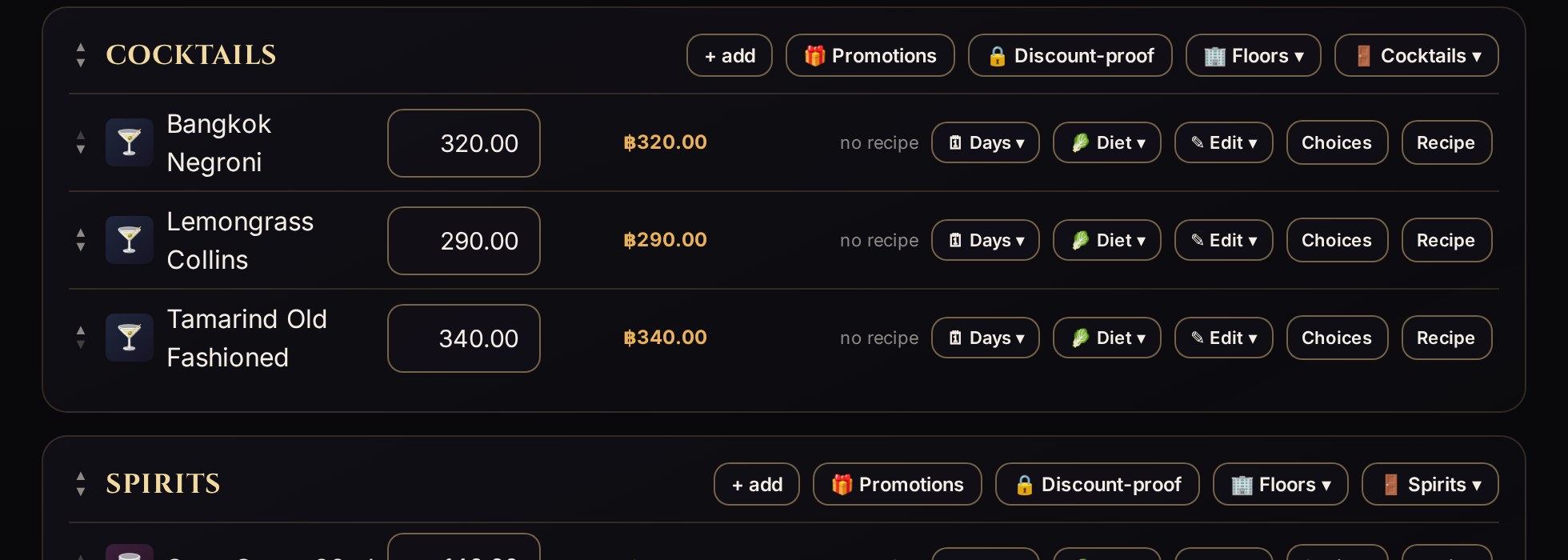
The menu editor: cocktails with their prices in editable fields, plus recipe, availability and diet controls

The menu the guest sees

Edited by you, in the back office, live.

01Bilingual, item by item

Thai and English in your own wording, not a translation engine’s. The guest picks a language; the kitchen ticket stays in the language the kitchen reads.

02Out of stock means out of stock

86 a dish and it stops being orderable on every phone already looking at the menu. No round arrives for something you ran out of an hour ago.

03Variants and modifiers

Half pint, double, extra shot, no chilli — each with its own price difference, added or subtracted from the base price rather than maintained as a separate item.

04Happy hour prices itself

A promo is evaluated at the moment the line is ordered, not when the bill is closed — so a table that orders at 18:55 and pays at 23:00 still gets the 19:00 price it was promised, and one that orders at 19:05 does not.

05A price change is instant

Change it in the back office and the next guest to open the menu sees it. There is no publish step and no second system to remember.

06An order remembers itself

Every line stores the name and price it was ordered at. Edit or delete the menu item afterwards and last night’s bill still says what it said — which is the difference between a receipt and a guess.

Honest limits

What QR ordering is not.

It is not a replacement for your waiters. Venues that treat it as a headcount cut usually go backwards. What it removes is the transcription — the docket, the re-typing at the till, the round that was written down wrong — and what it frees is the part of the job guests actually notice. Your staff still greet, still recommend, still fire every round.

It is not the only way to order. Staff take orders on the same system from their own screen, for the table that would rather tell a person, for the walk-up at the bar, and for the guest whose battery died. The QR is a door, not a turnstile.

It does not work with no internet. The guest’s phone reaches a server over the internet. If your line is down, ordering stops — which is why we would rather help you put a 4G router in as automatic backup than tell you it never happens.

Keep reading

What happens after the round is fired.

Come and see it running during real service.

Not a demo account full of invented data — a live venue on a Friday night, taking real orders. Bring your menu and we’ll have it on screen before you leave.