Most venues run four systems that pretend to be one: a till, a spreadsheet, a paper docket book and an accountant’s inbox. Sabai POS is the four of them written as one thing, so a number entered once is the number everywhere.
The floor
A signed QR sticker per table opens the menu in the guest’s own browser — no app, no account, no wifi password. The session binds to that phone, so a second device cannot pick up an unpaid bill.
Tables drawn where they really are, across as many floors as you have, each showing free, seated, ordered or waiting to pay. Drawn once in the designer, by you, without calling anybody.
Every round a guest sends waits for a staff member to fire it. Nothing reaches a station unchecked, which is what makes a photographed QR harmless rather than an incident.
Thai and English item by item, in your own wording rather than a machine’s. Guests read the language they picked; the kitchen ticket stays in the language the kitchen reads.
Mark a dish unavailable and it stops being orderable on every phone already looking at the menu. Nobody orders the thing you ran out of at nine.
Move a party to a bigger table, merge two bills, or split one across cash, PromptPay and card. The tax invoice follows whatever you decided.
The pass
Each item on the menu knows which station makes it. When a round is fired, food goes to the kitchen screen and drinks to the bar — the same round, in two places, at the same second. An item that belongs to both stations produces a line in each.
A ticket appears the moment a waiter fires it, ages visibly while it waits, and clears when it is bumped. Read more on the kitchen display page.
Screens are the default because paper is the thing that gets lost. A receipt printer is supported, and a docket printer at the pass is supported — they are just not required.
A round can be held rather than fired, so starters land before mains without anyone standing at the pass doing arithmetic.
The books
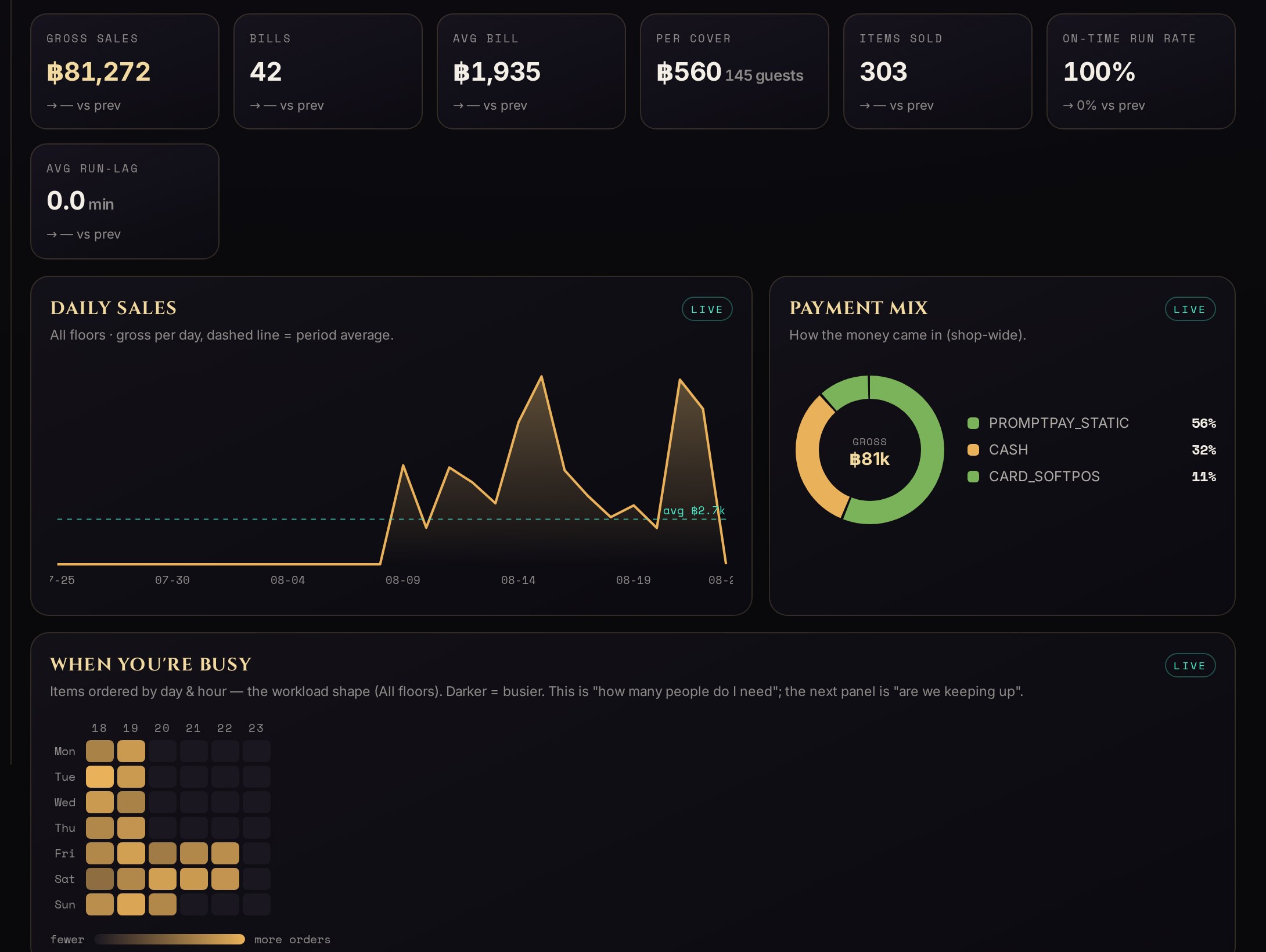
Sales, payment mix, average bill, items sold, and the margin underneath them — because gross takings on their own have never told anyone whether a venue is working.
Stock down to the pour. Recipes cost every drink and every dish from the ingredient library, so a 30ml measure comes off the bottle when the drink is sold. Variance between what should have left the shelf and what did is a number you can look at rather than a feeling you have at stocktake.
A Z-report that freezes. Each trading night closes into a numbered Z-report at 6am — a business day runs 6am to 6am, so a night that runs past midnight stays in one report instead of splitting at the stroke of twelve. Once frozen, the official total cannot be quietly changed later.
The nightly summary. What the venue took, on your phone, without opening anything.
The people
Which is why the interesting controls are the ones pointed inward. Every staff mutation is written to an append-only audit log with who did it, when, and what the value was before — and a void or a comp requires a written reason.
A waiter can send a round. Only a manager can comp one, reprice one, or open the drawer. Granted per person, not per shift.
The database itself refuses to delete an audit row, and the trail is exported off the box every hour. A control that the actor can remove is not a control.
Counted in, counted out, and the difference attributed to a shift and a person rather than discovered a week later.
Staff sign-in can be pinned to devices you have enrolled, so a PIN alone on an unknown phone is not a way in.
Standing discounts, credit ceilings and bottle lockers for the people who keep the lights on — with the ceiling actually enforced.
Taken every night and held off the machine that made it, encrypted. A backup on the same box is a copy, not a backup.
Thai tax
Thai law charges VAT on the subtotal plus the service charge. Software written for somewhere else charges it on the subtotal alone, and the bill still looks perfectly normal — it is short by ฿7 on every ฿1,000, every bill, all year, until somebody checks. Sabai POS calculates it the way the Revenue Department expects, allocates invoice numbers with no gaps, and never deletes a tax document.
This is the single most consequential thing on this page, and it has a page of its own with the arithmetic written out.
Honest limits
If the honest answer is “not yet”, that is the answer you will get from us before you buy rather than after.
The system runs on a server your venue reaches over the internet. A total outage stops ordering. We will help you put a 4G router in as automatic backup, which covers the failure you are actually likely to meet — your building’s fibre — and we will not pretend it covers ours.
The guest menu is fully bilingual. The staff side and back office are English, with Thai in progress. Ask us where it stands before you decide.
Card details never enter this system — the payment SDK holds them. We store an authorisation result and a reference, which is all a POS should ever hold.
Keep reading
Not a demo account full of invented data — a live venue on a Friday night, taking real orders. Bring your menu and we’ll have it on screen before you leave.
Tell us a little about your venue and we’ll arrange a time to show you the system running during real service.
We generally reply within 24 hours.
Anything at all — pricing, migrating off your current till, whether we fit a venue like yours. A real person answers.
We generally reply within 24 hours.